We did not imagine this. We lived it.
Two cousins. Two people we love. One of them was our grandmother.

The day the word entered our family.
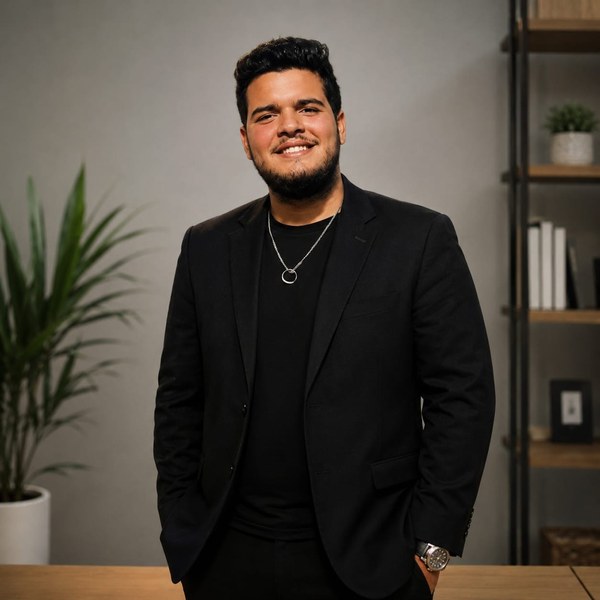
We are Aziz and Seif. We are cousins, and we grew up in the same kitchen, at the same table, fed by the same woman. When the doctor said Alzheimer’s, nobody in the room knew what to do with the word. There was no plan. There was a leaflet.
What came after was not one moment. It was thousands of small ones. The first time she called one of us by the wrong name. The first meal nobody could account for. The first night she was up at three in the morning, frightened, in a house she had lived in for forty years.
Loving her was easy. Carrying it was not.
The whole family showed up, and that was the problem nobody warns you about. Six people, six phones, six versions of how she was doing. Someone gave the evening medication. Someone else thought nobody had. The one who lived closest carried everything and slowly stopped sleeping. The ones who lived far away felt useless and said the wrong things on the phone.
We did everything we could to keep her world steady. Her music. Her routines. Her food, around the three other conditions she was living with. We read everything. And still, at 3 a.m., we were alone with a search bar and a woman who did not know why she was awake.
Then it happened to a second person we love, and we watched a different family fall into exactly the same holes.
We looked for help. We found forms.
We tried the apps built for looking after ageing parents. Pill reminders. Task lists. Trackers that treated her like a patient and us like staff. Nothing understood the disease. Nothing knew what stage she was at, nothing spoke to the whole family at once, and nothing, anywhere, was built for her to open herself with dignity.
We could not find a single one built for the family around her. So we kept a paper notebook on the kitchen counter, and we kept arguing on the phone.
The day Oramemory was born.
One evening, after another night like all the others, we said the thing out loud: the product we had wished for through every one of those years did not exist, and we were the ones who knew exactly what it needed to be.
So we built it the way we wish someone had built it for us. Not from a whiteboard, but from a kitchen table. Then we went and sat with other families, with doctors and care centres, to make sure our grief had not made us wrong. It had not. Everyone described the same week we had lived.
We are still asking.
Before writing a single screen we listened: to families, to neurologists, to care-home directors, to people living with the diagnosis. We read the research and then we went and asked whether any of it was true in a real kitchen. That listening is not finished. The first fifty families are part of it, which is why they keep Oramemory free for life.
If you have a story like ours, we would like to hear it. Write to us at hello@oramemory.app. One of us reads every message.
We thought our family was unlucky. Then we looked at the numbers, and understood we were describing the most common story in the world.
Behind every one of those numbers is a family like ours, a kitchen table, and someone awake at 3 a.m. That is who Oramemory is for.
Seven things you can hold us to.
We will never claim to cure, treat, prevent or slow this disease.
Anyone who tells you otherwise is selling something. We help you carry it.
We will never sell anything about her, or show an ad.
Her life is not our data. Read our privacy page; it is written in plain words.
We will never test her memory.
She has a doctor for that. In her space, nothing is a test.
We will never use the word patient with her.
Or monitoring, or tracking, or decline. She is a person with a name.
We will never show you a testimonial we did not receive.
Until families give us their words, you will see the research and the two of us.
We will always put a source next to a figure.
If we cannot source it, we do not say it.
We will refund you if it did not help.
At the end of your year, one email, the whole year back.
We could not build this for her in time. We built it for you.
If you are reading this at 11 p.m. after a hard day with someone you love, you already know why it exists. Be one of the first fifty families. It stays free for you, for life.
Check your inbox to confirm. We will write once, when it arrives on the App Store, and not before, unless it is to tell you that you are one of the first fifty.